Learners can feel the difference
Learning design is fundamentally connected to the creation of a hospitable learning environment. Educational institutions that ignore this warning do so at their own peril.
We live in harsh economic times. The mantra 'more for less' is surely the virtuous life-goal for every aspiring manager. At every point people are increasingly aware of the tension to stay afloat while cutting corners. The solutions aren't obvious much of the time and there's always the present danger of losing something essential to the buoyancy of whichever life raft you are sitting in.

“More for less” has one or two issues, believe it or not.
Figuring these things out is where learning design comes in. What can you let go of? What should remain at the heart of this thing? Movable feasts vs immovable objects. It takes wise reflection and prudent application to find that peculiar 'sweet spot' in any context that gets you more bang for your buck. There was never a greater need for careful observation and thought when it comes to setting up outstanding learning opportunities.
In the many schools I have worked, I felt that peculiar first hand pressure to get traction in the classroom when everything was usually stacked in the opposite direction: unwilling participants, biological factors,¹ strict time slots, multiple distractions (from all angles) and then your own personal energy limitations as an often lonely figure without support in a sea of expectation (it's okay, I am laughing a little as I write that overly tragic description - but you get the idea). Education is never conducted in an idyllic vacuum - there are always contextual factors to be negotiated and used to find the best possible options for effective learning.
In a nutshell, I think you need the following things as a minimum:
Skilled instruction
Accessible resources
A trusting, hospitable environment
I want to focus on the third with the full recognition that the first two lean heavily into its success.

Dr David I. Smith is a Professor of Education in Michigan who has written some really helpful words on this subject.² His book 'On Christian Teaching' picks up on something so important I made a short video about it:
In any teaching context there are going to be peculiar factors which require careful handling to get the correct balance. You won't always get it right but it's important to recognise what you are or aren't aiming for. (Borrowing from Dr Smith) I am convinced that the curation of a warm and trusting environment is absolutely essential.³
This will of course look different in one million ways but learners know the difference between being a mere data point on a conveyor belt and a person making a valuable journey of discovery.
One example from recent years has been the GCSE exam system.⁴ In the best cases, a well-connected, holistic department would deliver inspiring material and lead students forward with a sense of excitement about what was emerging on the journey. Unfortunately, I saw many examples of dead-eyed and fed up teenagers who had lost enthusiasm because it was all so exhaustive. At some point, somewhere, all the efficiency dots had been joined up by relentless managers. Aspiring high schools now resemble F1 pit-crews where every split second counts.⁵ All of these students knew they were doing something worthy but the spark of life had gone. I could go on to talk about the many online courses I have endured as an adult where my own spark was progressively being snuffed out but I think I'm in good company here.
This is where the curation of a hospitable learning environment becomes a crucial priority. Remember that a successful restaurant isn't just sending you a plate of food through a metal hatch. There is an entire framed experience that means people will wait to get access for its trusted quality and care.
In the same way learning organisations must think carefully about those details which communicate a similar sense of security. Does every learner feel known in some way? Are their needs noticed? Is the course content appropriately challenging enough to provide a fulfilling experience of growth? Or is it carelessly administered - making it a frustrating time of failure - or boredom?
The choice of courses being offered, the pace of completion, the level of accountability at play. These are all coded aspects of the environment that learners are stepping into.
Factory conveyor belts run and run with little care for what they are conveying. They don’t care where they send it or if it falls off and smashes. A learner feels the difference between being an object shuttling down a one-size-fits-all factory line and something more carefully prepared.
What do your learners feel about the environment you are providing?
When I was a high school teacher I worked hard to forge meaningful unique connections with classes - occasionally renaming groups who had been designated impersonal timetable codes (I chuckle at how 10x2 became The Pineapple Gang... I remember the satisfaction of getting them to write it proudly on the front of their books). Straight away there was a sense of personal connection which challenged any sense of being cells in a spreadsheet. I never wanted that dead-eye stare to infect my classroom. It was a warm home for learning, not an impersonal delivery system.
More recently, working for Crosslands - where most of my efforts are focussed online (surely the most impersonal of all possible environments?) I have to find other kinds of solutions. For a start we work hard to push against the sense that users are logging into an impersonal 'platform'. Each course has carefully considered resources - hand drawn illustrations, clear explainer videos carefully located, opportunities for meaningful reflection. We also work hard to emphasise the importance of participating in learner communities alongside our digital offerings.
There is an unexpected richness in connecting, sharing and listening to other learners who are on a similar pathway. Solitary study - however well resourced - is not enough. Therefore a fundamental characteristic of the Crosslands offering is that the learning is offered as a means of growing existing communities - not as an end in itself.
¹ Puberty, dear reader, puberty.
² Although Dr Smith is speaking into an explicitly Christian educational context in the US, his observations are wide-ranging and well worth considering. I have taught in numerous so-called 'secular' settings here in the UK and pretty much everything he says in this book has been immediately applicable in my mind.
³ I realise that there's a lot more that Dr Smith unpacks in his book about the often ignored link between pedagogy and ideology.
⁴ For non-UK folks: a General Certificate of Secondary Education across multiple subjects taken at around age 16. Everyone has to do it by law so you can imagine the best and worst of this.
⁵ Of course there's wholesome truth to this - who wants a poorly run school - but the pendulum has swung so far the other way that it has wrapped tightly around the breathing chords of an entire generation.
The story of Joseph - compressed into one image
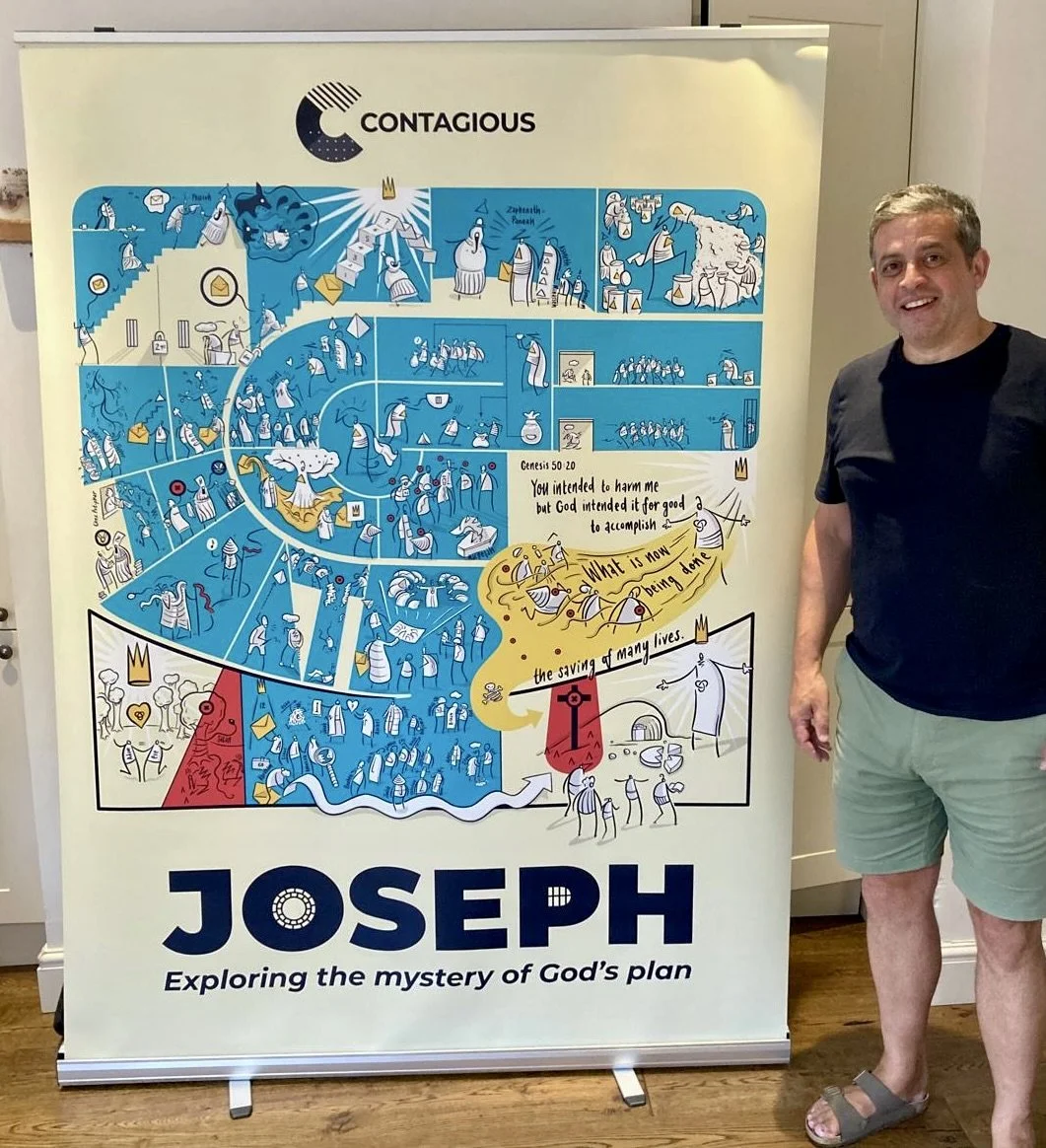
Previously I wrote about my efforts to reinterpret the story of Joseph into a visual form. Most recently I have taken that material and compressed it into an infographic that can be broken up into 30+ separate pieces. The idea is to use this with approximately 1000 teenagers to explain the story this summer. It will be printed large and broken up for booklets/slideshows.
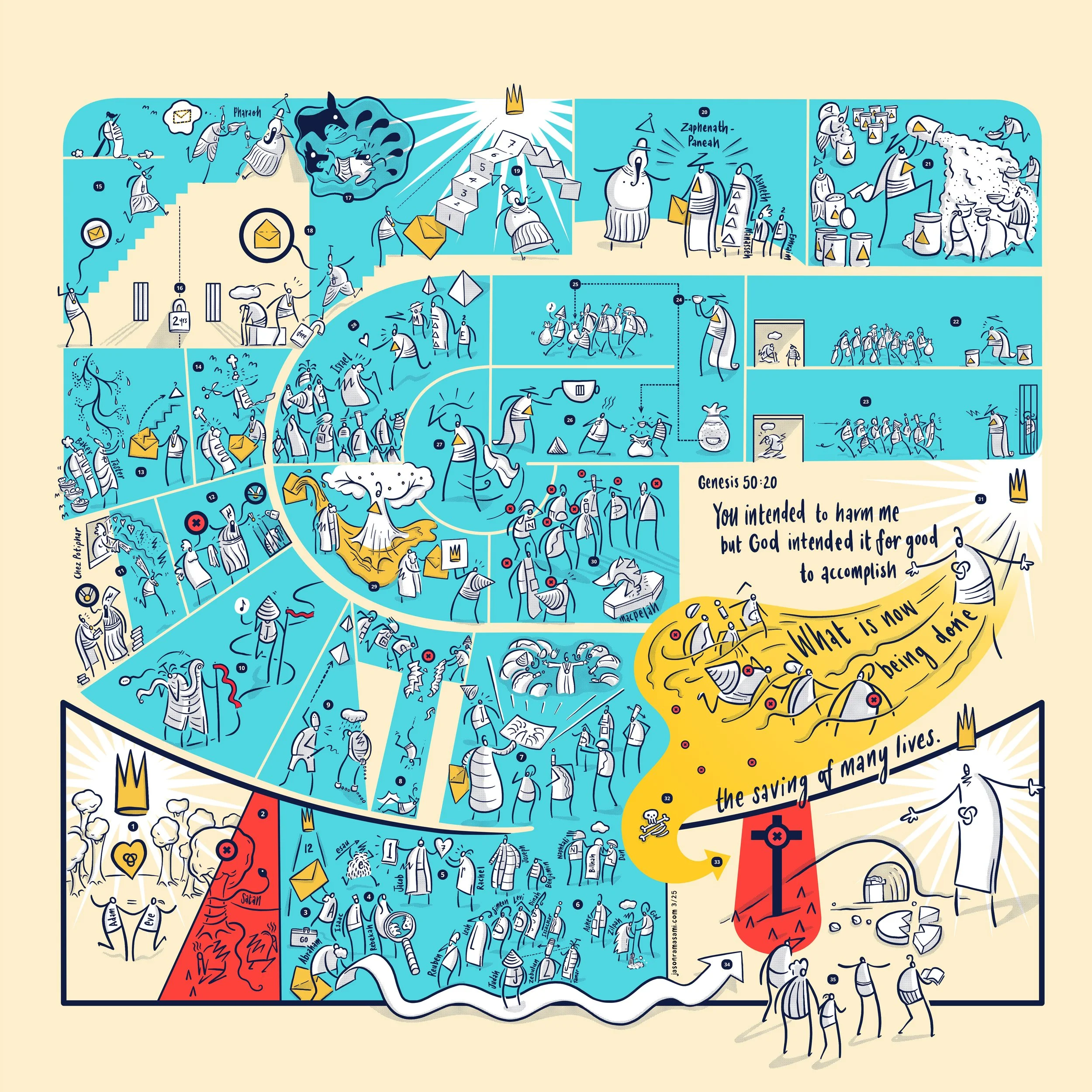
Here is a timelapse (if you are into that kind of thing) which will hopefully prove beyond doubt that it wasn’t created with AI.
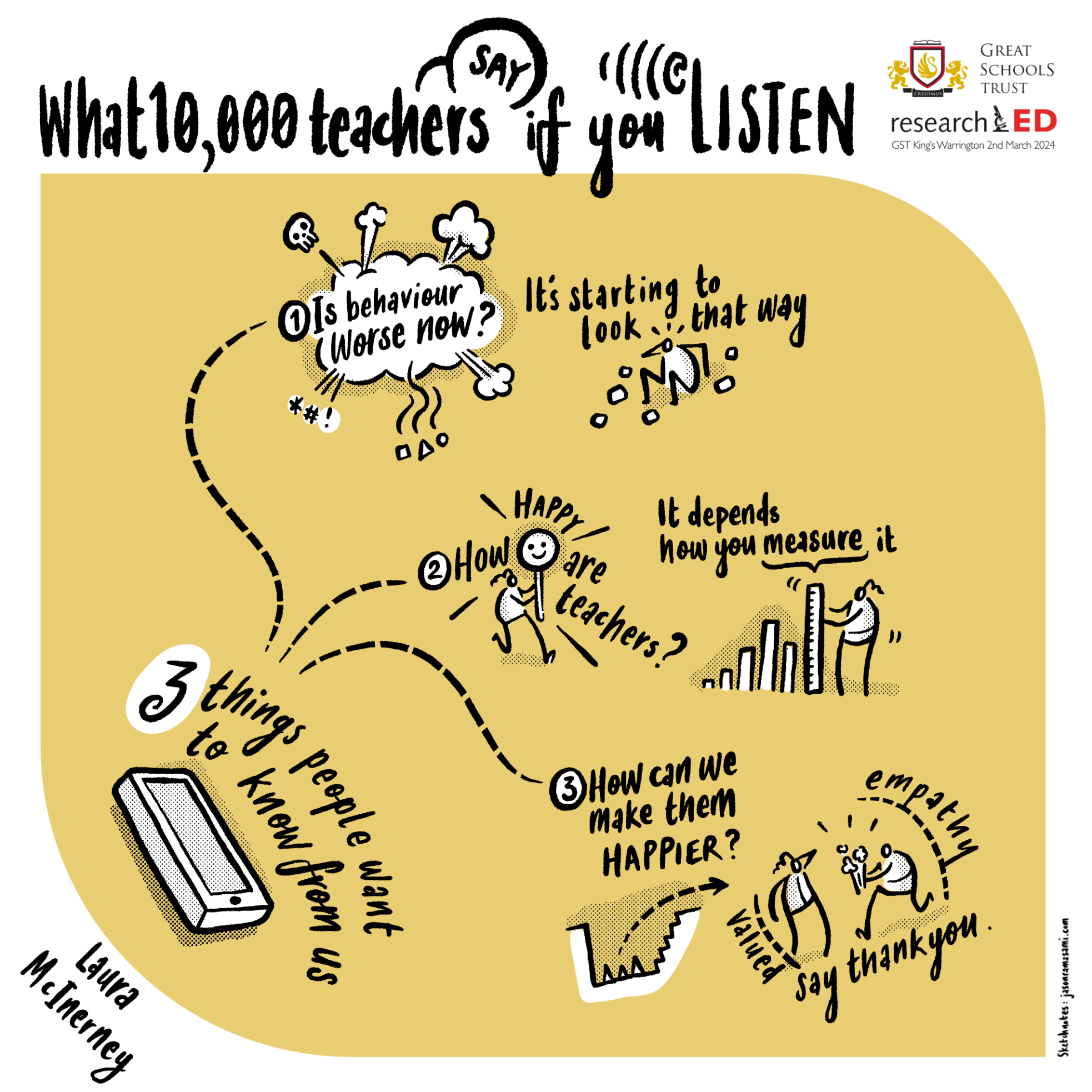
ResearchED Warrington Sketch-notes
Thankyou Michael Chiles and the Great Schools Trust for the invite to do some visual scribing for the keynote speakers at this impressive event back in February. Here are the final pieces:
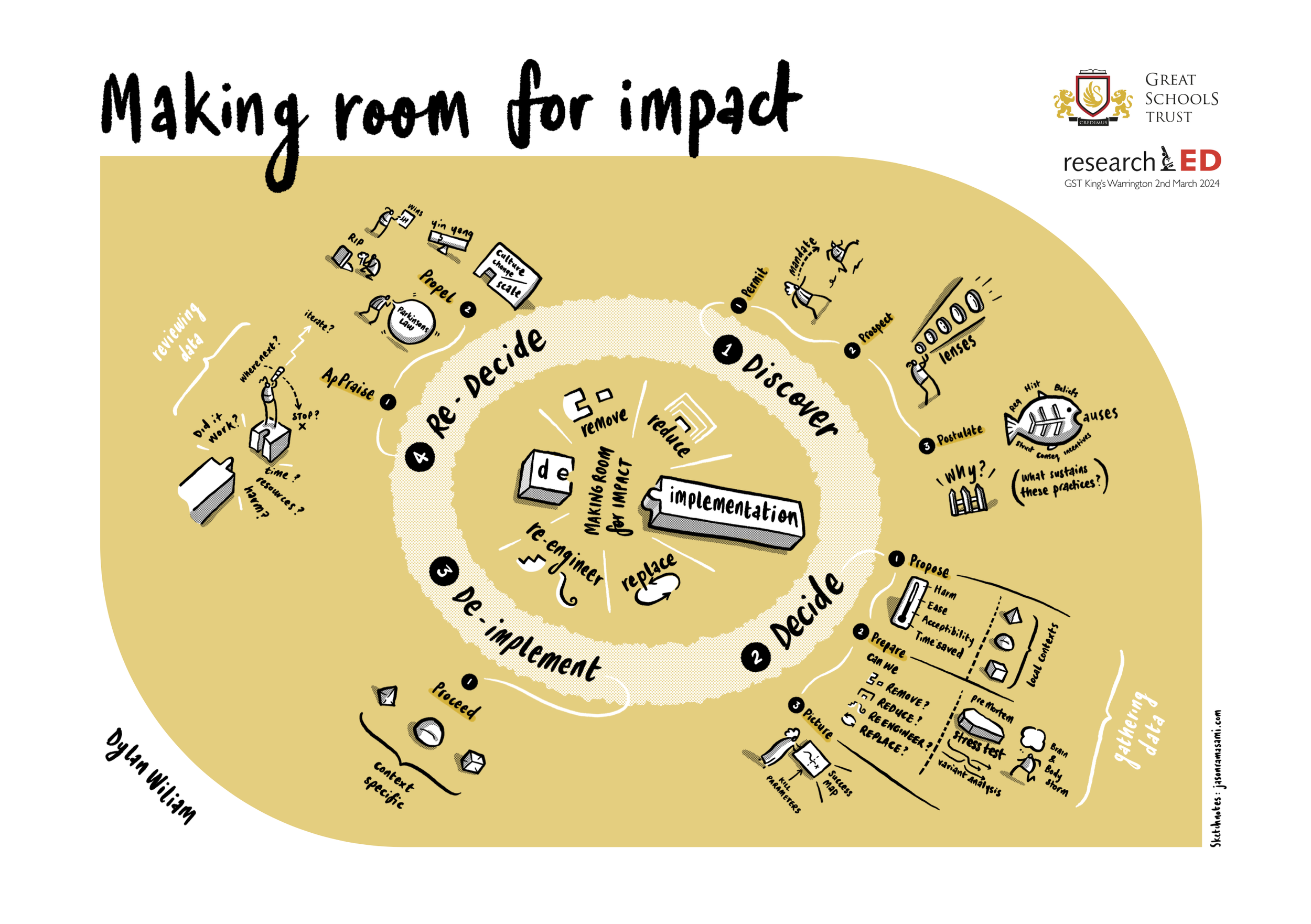
This was based on Dylan Wiliam’s main talk - a decent quality pdf can be downloaded here.



RunNotes: increments with the format and process
I thought it was worth writing up some of my current process thinking. I have been able to complete three RunNotes films just recently and each time I have another go at these things I inevitably change the way I operate because it’s always so difficult to put them together.
Let’s start at the ending(s) shall we?
In late December I visited Nottingham for a work trip. I decided to run from Bramcote to the Ratcliffe-on-Soar power station. As it was due for decommissioning in September 2024, I felt even more compelled to go there. The route I planned (using the brilliant footpath application) took a twisty journey along the Trent river and Attenborough nature reserve.
Here’s the film I ended up with:
Then on Christmas Eve, no less, I decided to give Bognor Pier to Worthing Pier a go - picking my way along the coast line.
This is it:
And finally - in mid January - inspired by the idea of travelling from Pier to Pier I decided to go from Worthing to Brighton.
This was a lot shorter than the Bognor route (and more boring). So I wondered whether I might try something more adventurous. I came up with a Devil’s Dyke detour taking in some of the Three Forts route before concluding with a downhill approach into Brighton.
This was a terrific experience with plenty of memorable moments - not least the cows and gliders. Here is the final piece:
Process changes - in brief
Please excuse me if this is brief.
1: Filming: GoPro and iPhone
The principle is here about capturing things without any friction or interruption. I carry a GoPro in my running short pockets - no longer using any handles or added gizmos (just a spare battery in my backpack). If I see something I will film it quickly and easily without needing to stop. For more complex shots I might pause and get my iPhone out - for the clips above I used the superior lenses for key moments. Having both on me makes a difference.
2: Animating: Apple Motion and Affinity Designer
After that previous blog post about maps I now do the following:
plan the original route in footpath, exporting to WorkOutdoors for a guide during the actual run
bring the completed run GPX data from WorkOutdoors back to Footpath to use for reference
produced my own large-scale blank canvas using the screenshotted images like so:

This is a screenshot in Motion. I actually used a grid to export tiles from Affinity Designer to make is easier when compositing as the pixel count is quite large…
NOTE: the 1080p window is the small highlighted area in the bottom right corner
I use PixelMator Pro to send SVG files into Motion (such a useful workaround)
from here it was a mainly a matter of using the WriteOn function and animating the camera
the route uses a duplicate vector underneath to achieve the thick black edge
I export two versions - one in standard H264 and one with the 4444 codec to allow for occasionally superimposing the route above footage
The main change is to keep things moving in the edit. No one really cares about stopping and starting so I constructed a continuous moving line rather than having it slow down and pause at different destinations. It makes for a much quicker feel in the edit.
3: Editing: humanity behind those buttons
I am regularly amazed at how strenuous it becomes making these little films. I have tried to streamline the process (and to a certain extent I’ve made some progress) but it’s still true that editing is never simply a matter of pressing some AI button and trusting the result! There is human artistry in feeling the flow of imagery which cannot be handed over to a soulless workflow.
Where the process has improved for me - is having a sense of how to prepare the different assets so I can flexibly arrange them in the timeline. I love the idea of being aware of this now when I am running so I know what will translate well as I’m filming it. In the end, editing insights eventually influence the earlier production stages.
arrange the material into usable compressed chunks on one timeline (this has tended to be up to about 12 minutes in length)
create a much tighter highlights edit (30 secs up to a minute)
final combo timeline combining everything (aiming for around 3-6 minutes ideally)
Other thoughts
These three films combine some incremental changes that I think make for a more entertaining watch:
an overview map title at the start and end
a super-fast highlights intro reel to whet the appetite without (I hope) killing curiosity
a shorter running time of 4-6 minutes long (which seems really different compared to the Isle of Wight piece)
Finally - the big idea with these is to avoid the endemic YouTuber Army narcissism by focussing on the route experience rather than the runner. No one really needs to see more of me but we could all do with getting out more and exploring those sights, smells and general feels.
What’s next?
Now I have a good sense of what these pieces look like I have two projects on the horizon:
next week I am heading to the so-called Jurassic Coast
at the start of May I am reuniting with my old mate Gary Luigi to run from Eastbourne Pier to Brighton… a mere 27 miles…
Thanks for reading - hopefully some of this is useful - get in touch to let me know if you were helped in anyway.